Untitled Document
Grow seaweed - add value - win markets
SEAPlanet Foundation
The South East Asia Seaplant Network
Tuesday, Jun 09, 2026
Untitled Document
Home News Publications Links Services Trade Data Contact Us Guest Book SEA Partnership


Table of contents | Introduction | Value chain structure | Foundation links | Process links | End links  | Anatomy of an enterprise | Features of SME | Specialty crops & trust | The nature of transactions | The nature of governance | Types of governance | Governance games | Alliance structure | Forming alliance networks | Enabling solutions | Crop production tools | Value-adding solutions | Metamediary functions | SEAPlant.Net websites | Glossary | Acknowledgements
The nature of governance

 Eucheuma Seaplant Value Chains and SME Alliances
SEAplant.net Technical Monograph No. 0804-6a

The nature of governance

Page 12


Governance systems are the mechanisms by which enterprises and transaction systems are directed and controlled. According to OECD (1999) the structure of business governance systems is such that:

1. They specify the distribution of rights and responsibilities among different participants in value chains, and alliance networks such as managers of partner enterprises and other stakeholders.

2. They spell out mutually agreed rules and procedures for making decisions on business affairs.

3. They provide the structure through which business venture objectives are set and the means of attaining those objectives and monitoring performance.

One of the critical enabling solutions for any value chain or alliance network is the development and support of clearly understood governance systems. Three governance systems applicable to SME alliances are

1. Legal governance systems
  Legal mechanisms include contracts, certificates, deeds, financial reports and other written legal instruments that specify sanctions in relation to compliance
2. Hierarchical governance systems
  Hierarchical governance systems are based on explicitly defined systems of authority, rank and layered reporting relationships. They are typified by the presence of powerful leaders.
3. Trust governance systems
  Trust governance mechanisms are based on established patterns of personal integrity, trust and commitment between individuals and among groups.

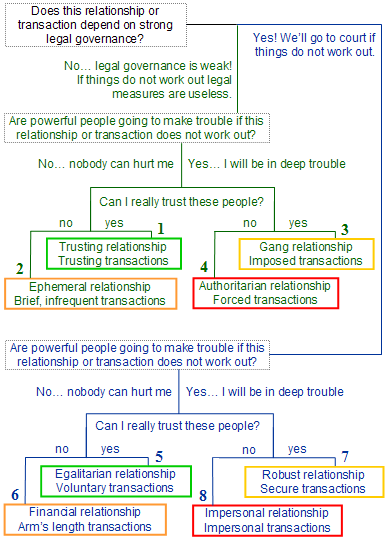
The decision tree presented below illustrates interactions among legal, hierarchical and trust governance. These interactions are discussed in pages 13-14.