|
Technology for growing eucheuma
seaplants and making PES from them has been more or less in the public
domain since the mid-1970s. Since then technology transfer has been piecemeal
and quality problems are commonplace. Commercial eucheuma seaplant
farming became commercially significant in the mid-1970s and this led
to commerce in alkali-modified whole plants. This was rapidly followed
by the advent of "chips" and it rapidly became obvious to several
value-chain participants that powdered, blended “processed eucheuma
seaweed” (PES) was suitable for a wide range of applications and was
significantly cheaper than clarified extracts in some applications.
Petfood stabilization was the first major application for PES but
food-grade products rapidly followed and the production of clarified
carrageenan extracts from PES raw material is also now an established
technique. During early stages of industry development much technology
transfer involved informal or dubious mechanisms such as “pirating” of
staff.. These approaches tended to provide yesterday's technology and
failed to address tomorrow's needs. Initial sources of know-how and
technology transfer included: |
|
1. |
The spread of "colagar"
technology to eucheuma seaplants. |
|
2. |
Internal development by existing
industry players and intentional technology transfer to their
suppliers. |
|
3. |
Movement of technical staff from
established industry players to aspiring new players. |
|
4. |
Manufacturers and consultants
selling previous clients' technology along with their equipment
and services. |
|
|
Today core technologies are creating
seaplant business opportunities at an accelerating rate. The tools of
biology and genetics complement the development of materials,
bioreactors and other tools to deliver rapidly developing
opportunities for seaplant technologies. Furthermore, emerging
enabling technologies provide tools such as information technology;
communication & transport systems; alliance management systems; and
process control systems. |
|
 |
|
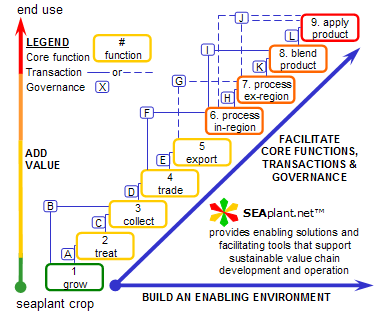
Value-chains are
series of value-adding functions that connect through governed
transactions and result in the supply and sale of products. |
|
|
 |
|
A generalized seaplant value chain structure
is shown above. Some people find it useful to view value chains as
“ladders” or “stairs” where each core function represents an upward step.
In order for sustainable value chains to operate an enabling environment
must be built, maintained and improved. The enabling environment is a
world of legal and hierarchical structures; trust networks; the physical
environment; and the social environment For most enterprises this means
dealing with an array of stakeholders… including alliance network
partners. Operation of value chains within enabling environments is
facilitated by tools that include information technology (IT); legal
documents; communication and transport systems; metamediary websites;
analytical services; and engineering design services. |
|

.jpg)

