|
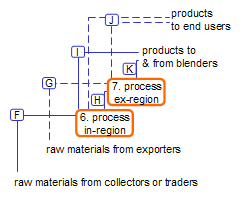
Process functions of eucheuma seaplant
value chains may occur either within or outside the same
jurisdictional region as seaplant farms. Process facilities tend to
cluster close to seaplant sources or close to markets. |
|
|
|
During early stages in the development
of eucheuma seaplant value chains virtually all finishing links
occurred outside the tropical regions where farms are located. Until
the late 1970s cold water carrageenophytes were dominant raw materials
in the carrageenan industry, most processing was done in the USA,
Europe or Japan and the market was dominated by three companies,
namely Marine Colloids (now FMC), Copenhagen Pectin (a.k.a. GENU; now
CP-Kelco) and Sanofi (now Degussa). These companies shared world
markets essentially on a 4:2:1 ratio, and smaller producers played a
role in small market niches. The advent of eucheuma seaplant
cultivation and consequent development of PES technology caused a
shift in value chain dynamics that is still underway. The advent of
massively expandable raw seaplant sources and technology for making
PES caused a step-change in the industry and the increasing
availability of enabling solutions is making it possible for small
regional manufacturers to compete on an increasingly "level playing
field" especially if they tie up with skillful blenders that have a
strong position in their regional market niches. |
|
 |
|
There is a growing trend for eucheuma
seaplants to enter international commerce as "chips" or "meal" rather than
as DES. minimization of PHT trading games is one incentive for this trend
and economics of production are another. The desire to avoid expensive
effluent treatment in developed urban areas is a further incentive for
using modified materials as raw material. Supply proximity can give
comparative economic advantage to local processors.
Sources of comparative advantage include: |
|
1. |
The PES process does not have
significant economies of scale and low-cost human resources can
confer a substantial advantage. |
|
2. |
Only about 20-35% of raw
eucheuma seaplant composition is realized as finished product so
transport cost savings result from processing near seaplant
sources. |
|
3. |
Processing close to seaplant
sources also provides savings in the form of quality retention;
process control; inventory control; and minimization of processing
steps. |
|
|
There is an emerging trend for strategic
alliance networks to develop among processors. Consequences of alliance
network development include: |
|
1. |
“Tolling" and barter
arrangements occur among processors in different jurisdictions. |
|
2. |
SME are increasingly able to
realize competitive advantage based on local comparative
advantages. |
|
3. |
Alliance networks have
increasing access to enabling solutions formerly available only to
large multinational firms. |
|
4. |
Eucheuma seaplant value chains
are steadily spreading into emerging markets such as China, India,
SEAsia and South America. |
|
5. |
Entrepreneurial and innovative
initiatives are better able to achieve sustainable success. |
|
|

.jpg)

