|
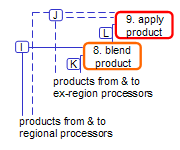
End links connect processing
core-functions with the blending, distribution, marketing and sales
functions that lead to the application of carrageenan end products. |
|
|
|
Most processors do some blending but
specialized blending houses play a major role in eucheuma seaplant
value-chains. Most carrageenan applications require that two or more
types of gum be blended with salts, sugars and other products to
create the mix that is used in end products. Many kappa carrageenan
applications require blends with synergistic glucomannans or
galactomannans. These indlude carob (locust bean) gum, cassia and
konjac gum. Some large, sophisticated customers such as petfood
manufacturers prefer to purchase standardized blends of "pure PES"
which they combine with other gums and ingredients at the point of
final product manufacture but this is more the exception than the rule
in other industries. Marketing, sales and distribution functions are
part and parcel of the blending function because most carrageenan is
sold as a "specialty chemical" or "ingredient solution". The "magic"
introduced at the level of processing and blending provides the
competitive edge for biopolymer "solution providers". |
|
The effective
application of biopolymers is often more art than science so blending
and applications skills are a valuable core-competency. |
|
|
 |
|
The front line of carrageenan marketing is
often cooperative R&D among blenders and end-users. The R&D staff of
leading solution providers have broad and deep knowledge that can be of
substantial use to enterprises developing new products. In extreme cases
the solution provider may do almost all of the product development work
for a customer. There is substantial inertia once suppliers are chosen and
approved for particular products. The biopolymer component of a product is
usually a small percentage of the product composition (e.g. about 0.5%)
and may represent a small proportion of final-product cost but the
biopolymer usually has a pronounced impact on product quality. This means
that users are reluctant to switch suppliers or to tinker with the
biopolymer mix once a product line has been established (see McHugh, 2003
pp. 48 & 71 for elaboration of this point). One product failure at the
level of a full-scale plant run can be far more expensive than the slight
saving to be achieved by buying a cheaper gum. Expertise has dispersed in
recent years.
When eucheuma seaplant cultivation became
commercially successful in the mid 1970s the carrageenan industry was
dominated by relatively few companies based in the E.U., Japan and the
U.S.A. Since then the following trends have taken place: |
|
1. |
Several innovative SME that
initially developed carrageenan value chains were absorbed into
large companies. |
|
2. |
Operating priorities of these
large companies caused outward migration of staff with an
innovative orientation. |
|
3. |
Several SME were founded as the
availability of eucheuma seaplant and expertise fueled industry
growth. |
|
4. |
"Globalization" based on the
availability of cheaper and better communication and information
technology is enabling industry players to innovate with renewed
vigour. |
|
|

.jpg)

